FlemingClans.com

"Scotland's Fleming Clan: a Genealogical History" - coming in 2027!
Estate: Lenzie
 Lenzie, Dumbartonshire
1314 - 1875
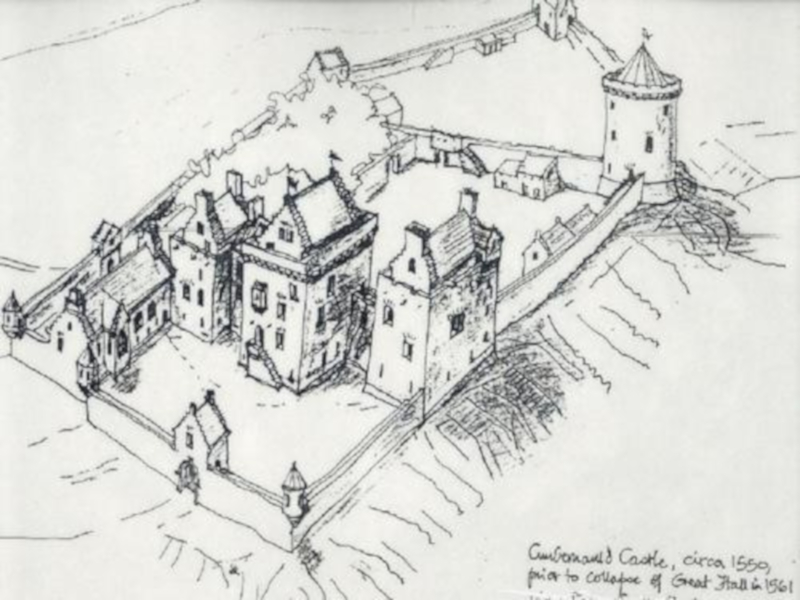
The barony of Lenzie, with Kirkintilloch and Cumbernauld, was granted to Malcolm Fleming by King Robert I after Bannockburn. It became the heart of the Fleming estates, Cumbernauld became the family’s chief seat, and the Lords Fleming took their title from it. The family held it for more than five and a half centuries.
Acquisition
In or after 1314 King Robert I granted Malcolm Fleming of Fulwood the whole barony of Kirkintilloch, formerly held by John Comyn, in reward for his service at Bannockburn. The barony is usually called Lenzie. King David II confirmed Malcolm, now Earl of Wigtown, in the baronies of Lenzie, Kilmaronock and Dalziel in free warren on 20 June 1341.
Estates within the barony
The barony included Kirkintilloch, with its lands, burgh and Mains; Cumbernauld, with its castle, forest and Mains; the kirk of Lenzie with its chapels and teinds; Bord, with Croy and Smithstone; Overcroy; Drumry; Sythboger; Gartangaber; Badenheath and Gartshore; Shirvey; Netherwood; Dullatour; Oxgang; Badcow; Auchinvole, Auchendavie and Garngaber; and Chapeltown.
Passing to the Biggar line
In 1358 King David II granted Malcolm Fleming of Biggar the lands in Lenzie that had been forfeited by John Kennedy. In November 1372 Thomas, 2nd Earl of Wigtown, mortgaged his lands in the barony to William Boyd for eighty pounds, and Malcolm of Biggar bought out the mortgage. On 20 September 1382 Thomas resigned the barony of Lenzie in favour of Malcolm, his cousin and male heir.
Cumbernauld Castle was rebuilt around this time to replace the old Comyn stronghold, and Sir Malcolm Fleming had royal charters of Cumbernauld in 1401 and 1406. The Fleming lands in Kirkintilloch were the subject of a long feud with the Kennedys from the fifteenth to the seventeenth century.
Lordship of Cumbernauld
In 1538 Malcolm, 3rd Lord Fleming, had his lands erected into five baronies, and on 18 January 1589 John, 6th Lord Fleming, had them erected into the lordship and barony of Cumbernauld, with Biggar and Kirkintilloch as burghs of barony. The estates were forfeited after the 5th Lord’s support for Mary, Queen of Scots, and Cumbernauld Castle was surrendered in 1570, but John, later 1st Earl of Wigtown, had sasine again in 1580.
Later earls raised money on the barony: from the Bruces of Airth in 1587 and 1588, from William Monteith of Kerse in 1590, and from Mr John Hay, parson of Renfrew, in 1632. In 1650 the 3rd Earl was ordered to garrison Cumbernauld Castle against Cromwell.
Disposal
After 1747 the lordship passed with Lady Clementina Fleming to the Elphinstones, and in 1804 the Court of Session confirmed Admiral Charles Elphinstone-Fleming as owner of Cumbernauld. His grandson Cornwallis Maude-Fleming was served heir in Cumbernauld and other Lenzie lands in 1867 and 1869, and sold the Cumbernauld estate for 160,000 pounds in 1875.